Category

Business & Finance

Comprehensive discussions and expert insights revolving around business & finance trends and best practices.

May 21, 2026 167 Reads

Industrial Air Filtration Systems for Cement, Steel & Chemical Industries

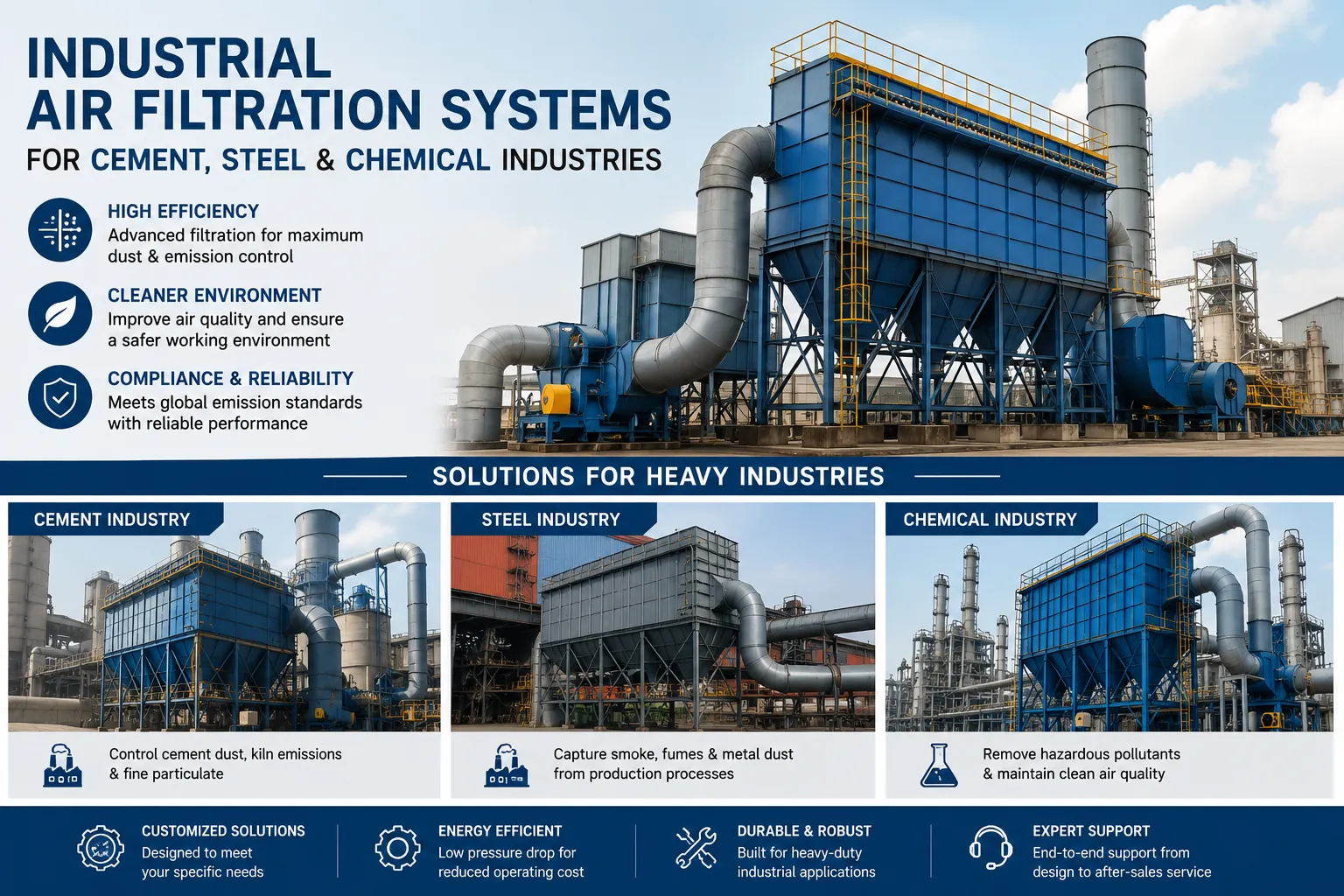
Modern industries get increasing pressure to keep production areas clean, while still meeting tough environmental rules, and audits. Industrial air pollution control systems are a big part of this work, because they reduce airborne contaminants, make worker safety stronger, and can even raise operational efficiency inside manufacturing plants. Things like cement, steel, and chemical processing produce big quantities of dust, fumes and other risky particulate matter that really need reliable filtration solutions, in practice not just on paper.Picking the right industrial air pollution control systems helps facilities reduce emissions, stay within compliance, and improve the overall air quality. Newer filtration methods also shield equipment from damage, plus they support more comfortable and healthier workplaces. For example, dust extraction units alongside high-performance filtration equipment are now common choices, when companies try to handle pollution in a sustainable way.Why Industrial Air Filtration MattersIn a lot of industrial production, fine dust, smoke, chemical vapors, and other particulate stuff end up in the air. If there is no proper filtering, those contaminants can harm employee health, mess up machinery, and even trigger legal penalties.A solid filtration setup is useful because it helps industries toImprove indoor air qualityReduce harmful airborne particlesExtend equipment lifespanSatisfy environmental compliance requirementsSupport steadier workplace productivityThese days, many factories are putting resources into newer filtration technologies, to keep things cleaner, and safer overall.Key Components of an Industrial Filtration SetupDust Collection UnitsAn effective industrial dust collector is basically the thing that grabs the airborne particles released during grinding, crushing, mixing, and various manufacturing steps. With these arrangements, dust buildup is limited, and explosion risk in the facility is reduced, too.Common dust collection technologies include:Baghouse filtration systemCyclone separatorsCartridge dust collectorsWet scrubbersEach system is designed for different particulate sizes and industrial work types, so you match the setup to what your process throws into the air.Air Cleaning and Ventilation SystemsProper ventilation removes contaminated air and replaces it with clean filtered air. Industries dealing with chemicals or high temperature processes especially benefit from advanced ventilation and extraction setups.Reliable filtration systems also help energy efficiency because they keep airflow steady, and they reduce equipment strain, in the long run.Industrial Air Filtration in Cement IndustriesCement manufacturing creates big volumes of silica dust and particulate emissions during crushing, grinding, and packing activities. An effective filtration system is essential to keep safe air quality inside and around the plant.Key benefits for cement facilities include:Reduced airborne cement dustBetter compliance with pollution standardsImproved worker safetyLower maintenance costsHigh-capacity filtration equipment is often placed near kilns, conveyors, and the material handling zones, so dust control gets the best results.Air Pollution Control Solutions for Steel PlantsSteel plants create smoke, metal particles, and toxic fumes when melting, cutting, and welding happens. With efficient filtration systems, production areas can stay cleaner, and workers are less exposed to hazardous emissions.A trusted air filtration system manufacturer can deliver tailored setups depending on factory size, production throughput, and emission levels. In steel sites, advanced installations commonly add spark arrestors, fume extraction units, and high-temperature filters that last longer.These arrangements also support operational efficiency by reducing airborne contamination around equipment, as well as along production lines, even when workloads increase.Filtration Systems for Chemical IndustriesChemical factories need specialized filtration solutions, because they work with gases, vapors, and also hazardous particles. Air filtration systems in these chemical plants are built to capture toxic substances in a controlled way, before they end up spreading into the surrounding air or environment.In practice, you usually find these filtration jobs happening:Vapor management setupsChemical fume extractionActivated carbon filtrationCorrosion-resistant filter unitsWhen air management is handled correctly, chemical industries can support safer workplaces and meet environmental regulations more efficiently.Choosing the Right Industrial Filtration SolutionPicking the right industrial air filtration system for your factory is something you don’t want to treat lightly, because a lot of moving pieces matter in a real plant, like what kind of production you run, the dust load, your required airflow, and the industry rules that apply. Also, businesses usually need to judge filtration efficiency as well as maintenance requirements, energy usage and long-term operational expenses before spending on anything.If you work with filtration experts who’ve done this before, you can get better system performance, plus more customized solutions for the specific industrial application that you actually have.ConclusionIndustrial filtration systems are essential to keep manufacturing spaces clean, safe, and efficient. Sectors such as cement, steel, and chemical processing lean on modern filtration technologies to control emissions, protect workers, and satisfy environmental standards. Putting money into strong dust collection and air purification systems can also help extend equipment life, and support steadier day to day productivity.If you are planning to upgrade your factory’s air quality management, partnering with a professional filtration expert can help you pick the best option for long-term performance. Invest in reliable industrial filtration technology today, so your facility can run with cleaner air and a more sustainable direction. Most importantly, you should look closely at an Industrial Air Filtration System for Your Factory because it supports steadier operations and better protection over time. Also, getting the right fit, in terms of airflow control and maintenance rhythm, can make a real difference.

G
Garant Filter
May 21, 2026 170 Reads

Best Billing Software for Small Business Your Quick Revenue Lift (2026)

IntroIn today’s fast-paced economy, small businesses are always looking for tools that save time, reduce errors, and improve the bottom line. One area that often slips under the radar but has a huge impact is billing. The right billing software doesn’t just generate invoices; it automates reminders, tracks payments, and keeps your accounts clean. If you’re searching for “Best Billing Software,” “Billing Software for small business,” or “Best billing software for small business,” you’re not alone. This guide will help you understand what to look for and how to choose a solution that fits your operations, customers, and cash flow.What makes billing software essential for small businessStreamlined invoicing: Create professional invoices in minutes, with your branding and tax details pre-populated.Automated payment reminders: Gentle nudges to clients reduce late payments and free up your time for other work.Recurring billing and subscriptions: For retainers or ongoing services, automation means predictable revenue.Real-time payment tracking: Know exactly who has paid, who is pending, and who is overdue.Compliance and tax readiness: Generate receipts and reports that align with local tax requirements.Choosing the right solution: key features to weighInvoicing capabilities: Look for templates, customizable fields, line-item detail, tax calculations, and multi-currency support if you deal with international clients.Payment integrations: Ensure the software supports the payment gateways you use (credit cards, digital wallets, bank transfers) and offers automatic reconciliation.Automation and reminders: A good system sends reminders before and after due dates, without appearing pushy, and offers customizable schedules.Reporting and analytics: Profitability by client, product line, and project; cash flow forecasting; ageing reports to spot at-risk accounts.Accessibility and user roles: Cloud access, mobile apps, and role-based permissions for team members and advisors.Security and compliance: Data encryption, regular backups, audit trails, and adherence to applicable data privacy laws.Pricing structure: Look beyond monthly fees—watch for per-invoice charges, per-user costs, and add-ons that may influence total cost.How to evaluate options with a practical lensMap your workflow: Identify who creates invoices, who approves them, who follows up on payments, and who reconciles accounts. Pick software that mirrors your process.Consider your client experience: Clients appreciate clear invoices, easy online payment options, and self-service portals to view statements and payment history.Test for scalability: If you anticipate growth, choose a solution that can handle more clients, more users, and more complex billing scenarios without a major upgrade.Check onboarding and support: Good vendors offer onboarding help, knowledge bases, and responsive support—especially during the critical first weeks after switch.Real-world benefits you can expectFaster payments: Automated reminders and easy checkout lead to shorter payment cycles and improved cash flow.Fewer errors: Pre-filled data and rule-based tax calculations reduce manual entry mistakes.Time savings: Automating repetitive tasks frees you to focus on client work, sales, and strategic planning.Clear audit trails: Transparent records simplify month-end close, taxes, and client disputes.Case for small businesses adopting a modern billing approachMany small businesses operate with lean teams. In these environments, a well-chosen billing solution acts like a part-time financial assistant. It handles routine tasks, flags overdue accounts, and provides insights that would otherwise require a dedicated bookkeeper. By standardizing invoicing across projects and clients, you also reduce ambiguity and improve customer trust. If you value predictability in revenue, a system that supports recurring billing can convert irregular income into a steady stream, which helps with budgeting and planning.How to implement with minimal disruptionPrepare a transition plan: Decide what data to migrate (invoices, clients, products/services) and set a realistic timeline that avoids peak business days.Run a parallel period: Use the new system alongside the old one for a short time to verify accuracy and iron out quirks.Train your team: Quick onboarding sessions on creating invoices, sending reminders, and reading reports ensure everyone is aligned.Communicate with clients: Inform customers about the new billing experience, including any changes to payment portals or due dates.A practical checklist for choosing the Best Billing SoftwareDoes it offer templated, branded invoices with automatic tax calculations?Are there flexible payment options and automatic payment reminders?Can it handle recurring billing and subscriptions if needed?Are reports comprehensive and easy to customize?Is the platform secure, compliant, and backed by reliable support?Is pricing transparent and aligned with your expected usage?ConclusionChoosing the best billing software for your small business is less about a flashy feature list and more about how well the tool fits your operations, saves time, and accelerates cash flow. Start with essential invoicing and payments, then layer in automation, analytics, and scalable capabilities as your business grows. The right choice will reduce administrative drag and give you clearer financial visibility, so you can spend more time serving customers and growing your business.

J
Johnathan Bailey
May 21, 2026 148 Reads

Why Every Investor Should Use an SIP Calculator Before Investing

With investing, everyone seeks to grow their money; they want to earn interest on savings. Still, getting started with investing is often quite daunting. There are seemingly endless choices and innumerable calculations. Most tend to invest in haste, without any definite plan. Initiate first, think later. There goes another cycle of stress and mistakes. An SIP calculator helps in bringing clarity prior to the investment.Simply Define SIPSIP is an abbreviation for Systematic Investment Plan. It offers a simple means of investing over regular intervals. You invest a particular sum on a fixed schedule. In some cases, this is an investment made by people every month. It could be a small investment for a long period. SIP fosters both regular habits of saving and discipline. In any case, proper planning is needed before starting any of these.What is an SIP calculator? The SIP calculator is a planning tool to help investors understand how the money can grow over time. It does not guarantee results. It only helps to evaluate the results. SIP calculators aim for clarity; they get the investors prepared on the planning side without uncertainty about the outcomes.Ways of using SIP calculatorsAn SIP calculator necessitates an input of three information points, namely, the investment amount in a month, the investment period, and the expected return rate. When all three are plugged in, the SIP calculator will spit out a quick estimate of the SIP value. This value will not be guaranteed at all and would be more for helping guide the investor as to some of the outcomes.Importance of Planning Before InvestingMany people simply invest without a clear plan. They start investing just because everyone else is doing it or the markets seem favourable to them. Such an approach usually ends in problems later. An SIP calculator brings an element of purpose to investing. Modifying the Plan Becomes EasySometimes the monthly SIP feels too large. In that case, the time period may be increased. The opposite might also happen: sometimes it feels too long to invest. So the amount may be readjusted. An SIP calculator provides the convenience of doing these adjustments. Therefore, the investors will hardly have any stress or confusion in altering their plan.Helps Set Clear ExpectationsMarkets are volatile, and returns are never in sync. Many barely understand the concept of moderate growth each year, and when such does not happen, disappointment follows. An SIP calculator helps set realistic expectations. It explains the various results that can happen under various assumptions on returns. This prepares the investors for the adjustments needing to take place and reduces the shock later.Shows How Important Regular Saving IsSaving regularly is fundamental to SIP investing. Regular saving of small amounts would grow steadily over a time frame. An SIP calculator proves this point. It describes how the growth of funds is slow at first and quicker during the late growth stage, given time. This information promotes the theory and bolsters discipline.Helps Compare Different ChoicesAn SIP calculator can help investors make comparisons among the different options in front of them. They can change the investment amount, the time period, or the return assumption. Every such change gives a new estimated result that eases the decision-making process and reduces the guesswork.Reduces Emotion-Based DecisionsMoney decisions are frequently affected by emotions. Fear brings in procrastination, while enthusiasm can lead to impulsive action. Both eventually cause a blunder. An SIP calculator, in essence, is a more structured approach, which puts numbers to weigh, thus enhancing self-esteem to make the correct decision calmly.Helps for Withdrawals TooInvesting is not just about putting money aside; it is also about putting it to use. This is where an swp calculator comes in. An swp calculator helps to estimate regular withdrawals and tells how long the funds will last given the amount of withdrawal and expected returns.The Computation of SIP, along with SWPThe introduction of the SIP calculator for slow capital accumulation will complement the investment benefits furnished by way of the SWP calculator. This profuse combination gives a complete perspective of the entire investment journey, underpinning long-term planning and financial stability.Easy for Everyone to UseCalculations are certainly the graphs of an alien territory for many; manual calculations are a slow and laborious affair. The SIP calculator is an easy tool to use. Encourages Long-Term ThinkingMarkets are moving every day, and short-term changes can be distracting for an investor. The SIP calculator shifts that focus onto the larger picture. Here, time and patience take precedence; that cultivates good investing behaviour.Final ThoughtsAn SIP calculator is simply a planning tool. It cannot predict returns, and it does not eliminate risks. An SIP calculator provides clarity and structure to aid better investor planning and discipline.

a
aditya singh